
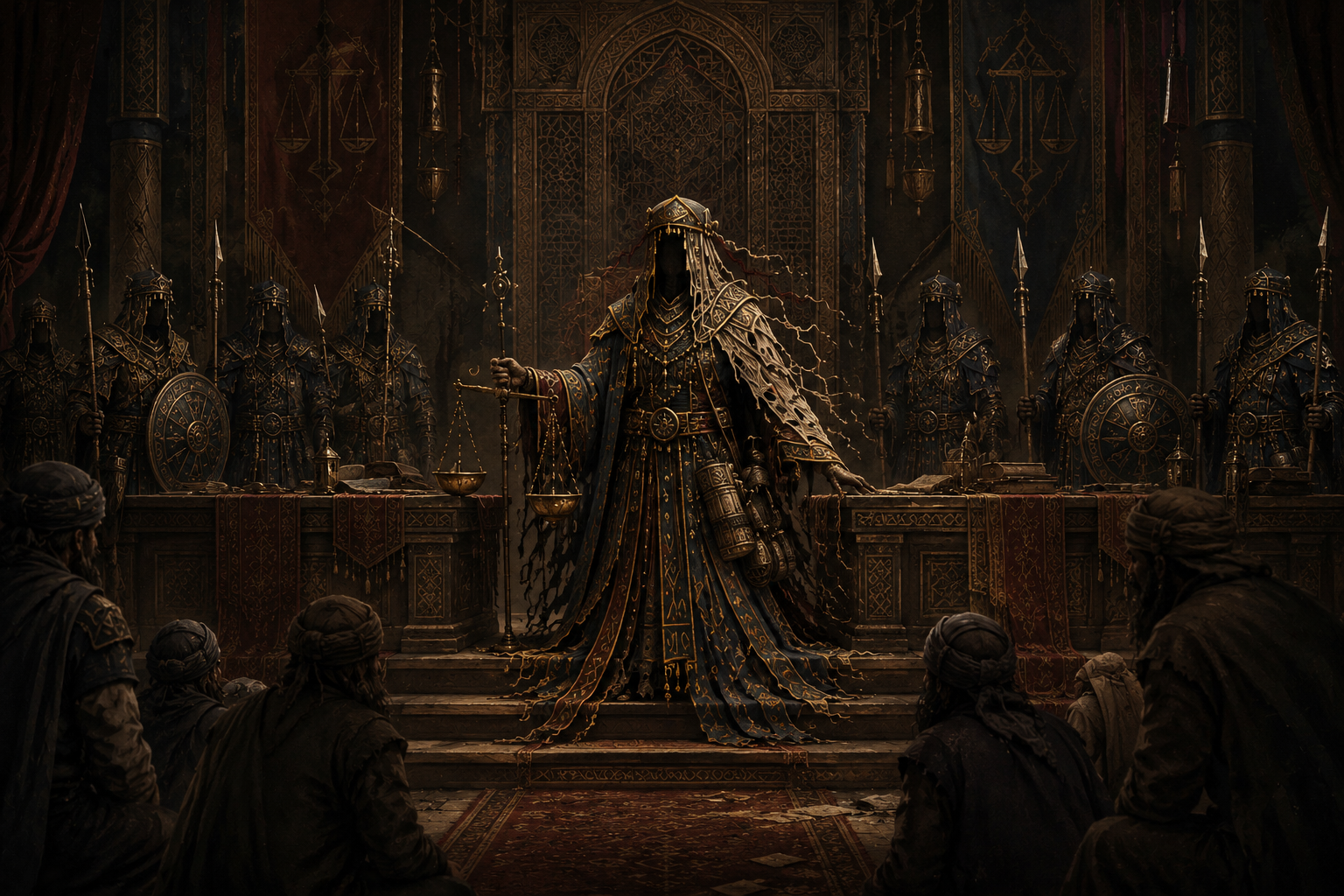
Clerks handling small cases that mattered deeply
A disputed animal, debt, boundary or promise can reveal how law touched daily life without turning every story into a conspiracy.
Diwan al-Hukm holds the civic weight of judgement, where clerks, petitioners, witnesses and families still carry the consequences of decisions.
THE FIGURE AT THE HEART OF THIS REGION
The Verdict
The people of Qamaris once came to Diwan al-Hukm believing that somewhere within its halls, right and wrong could still be separated. Disputes between families were heard here. Crimes were weighed. Testimony was recorded. Even the powerful were expected to answer when summoned.
At the centre of those halls sat Harun. Harun believed justice could not depend upon affection, anger, fear or rank. Not even the king stood above judgement. That belief made him invaluable to Samir — and, at times, unbearable to him.
As Qamaris approached its final days, accusations filled the Diwan faster than its scribes could record them. Neighbour accused neighbour. Soldiers blamed commanders. Officials blamed one another. Everyone wanted someone to be responsible. Harun continued hearing them, one testimony after another, one judgement after another, until eventually only one case remained: the case of the king.
And somewhere within the ruined halls of Rufat, the court is still in session.
This is foundational story context for contributors. The deeper cause of what happened to Qamaris is intentionally left unexplained here.
THE PEOPLE OF THIS PLACE
Start with a person, routine or relationship. Each angle below points toward a different kind of story.
A disputed animal, debt, boundary or promise can reveal how law touched daily life without turning every story into a conspiracy.
The waiting spaces matter too: shade, whispers, food brought from home and the tension of not knowing what happens next.
Let the same hall mean protection to one person, frustration to another and simple employment to someone else.
VISUAL LANGUAGE
Public halls, shaded waiting areas, records, benches and thresholds. Civic responsibility should be visible in the space without relying on European courtroom imagery.
EXAMPLE CONTRIBUTIONS
These are non-canon examples. Use them to understand the scale and tone, then take your idea somewhere different.
Two neighbours remain locked in a minor property argument that mattered enormously to them. Their conflicting testimony can be funny, frustrating and human without becoming a grand legal drama.
A meticulous clerk Echo keeps rewriting the final sentence of one ordinary case record. The player can discover why the wording mattered to the family involved.
Several family Echoes occupy the same shaded waiting area but repeat different moments of the same anxious afternoon. Their memories reveal how justice felt from outside the courtroom.
QUESTIONS TO CARRY WITH YOU
You do not need to answer every question. One strong answer is enough to begin a contribution.
What small dispute might have mattered enormously to two ordinary people?
Who could still be waiting for a verdict?
What record, token or object might represent a promise of justice?
IF SOMETHING SPARKED
A memory, character, sketch, room, object or unfinished thought is enough. The Workshop can help shape it to fit Rufat.